The tiger’s funeral
The Tiger RisingThe tiger’s funeral is the communal response to the tiger’s death after Rob and Sistine release him from captivity. The burial gives the children a way to mourn an animal they cared about, but it also brings Rob and his father into a moment of shared grief and tentative reconciliation. Its words and gestures hold together the event’s unresolved conflict: the tiger was beautiful and loved, freedom mattered, and Rob’s father says he shot the animal to protect his son.
Background and Stakes
The funeral follows a release shaped by competing ideas of freedom and care. Willie May refuses to tell Rob and Sistine to unlock the cage, asking them to consider how the tiger would live afterward. Her caution has a personal history: she once let a caged bird go because she could not bear its captivity, and her father punished her, insisting that the bird’s release had exposed it to danger. She never saw the bird again, though she says it sometimes appears in her dreams. That memory helps explain why she does not treat release as an uncomplicated good. The tiger’s immediate circumstances make the choice especially difficult. Beauchamp has considered using him to attract customers to the Kentucky Star Motel or killing him for his skin, and he hires Rob to feed him. Rob and Sistine nevertheless open the cage. The tiger steps out carefully, pauses, then runs away; Rob sees his movement as almost flight. The escape is brief: Willie May has fetched Rob’s father, fearing what the tiger might do once free, and Rob’s father shoots him. The funeral follows this reversal from apparent liberation to death.
The Burial and Its Rituals
Sistine calls the tiger a fallen warrior and insists that he deserves a proper burial. Rob and his father dig a grave with shovels, making it deep and wide enough for the animal; it rains throughout the work. The physical labor places father and son side by side in the aftermath of the shooting, while the weather marks the funeral’s mournful setting without resolving the questions that led to it. At the grave, Willie May says that nothing should be covered without words. Sistine offers the poem beginning “Tiger, tiger, burning bright / in the forests of the night,” then continues with lines asking what hand or eye could frame the tiger and where the fire of its eyes came from. She cannot remember the whole poem and turns to Rob. Her words give the gathering a formal language for the tiger’s striking presence, but Rob’s response is personal and plain: “I loved him.” His tears continue as he touches the tiger’s fur; the funeral allows grief to be expressed rather than hidden. Willie May contributes a small wooden bird, which she lays on the tiger’s body as company. She describes it as a little bird, not as a remedy for the tiger’s death. The gesture joins two histories of captivity and release: her lost bird, freed without certainty that it could survive, and the tiger, whose escape ended in death. Her offering makes her earlier warning part of the burial itself, without reducing the tiger to a lesson or making the outcome seem simple.
Family Grief and Aftermath
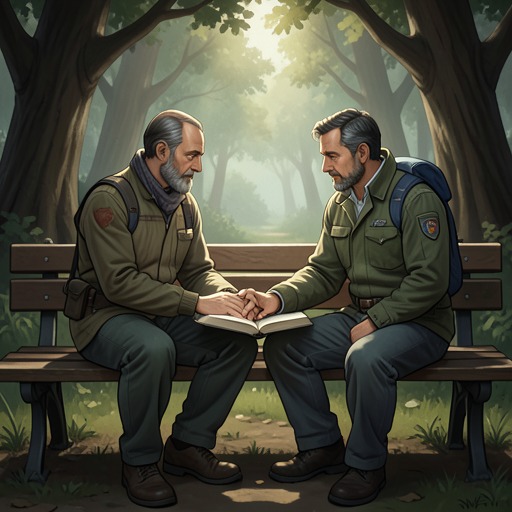
Rob’s father clears his throat and hums softly before saying that he had to shoot the tiger, that he is sorry, and that he did it for Rob. The apology acknowledges the cost of his action without undoing it. Rob leans into his father, and for a moment feels his father lean back. Their exchange takes place not through an explanation of the shooting but through grief, physical closeness, and the work of filling the grave. As Rob shovels dirt over the tiger, sunlight appears on his arm. He recognizes it as the sun showing up for another funeral. The return of sunlight gives the ending a restrained counterpoint to the rain, while the reference to another funeral connects this burial to the book’s recurring experience of loss. It does not erase the death; it arrives as Rob is finishing the act of covering the grave. Afterward, Sistine tells Rob that the tiger would not be dead if she had not made him release it. Rob answers that it is all right and that he is not sorry about what he did. His response does not deny the consequence, but it refuses to make the attempt at freedom meaningless. The funeral thus holds together remorse, love, and an unresolved ethical cost: the tiger is mourned as an individual, while the adults’ actions and the children’s choice remain inseparable from his death.
Narrative Significance
The funeral brings the book’s conflicts over captivity, responsibility, and grief into one shared scene. Willie May’s caution, Sistine’s conviction that the tiger should be free, Rob’s love for him, and his father’s claim that he acted to save Rob all remain visible; no single explanation cancels the others. The ceremony answers the tiger’s death with specific acts of care: digging, reciting, speaking, offering the wooden bird, and burying him together. For Rob, saying that he loved the tiger makes grief speakable. For his father, the apology and the brief return of physical closeness open a path toward reconciliation. The funeral does not turn the tiger’s death into a clean victory or an easy moral resolution. Instead, it lets the characters recognize what they have lost and remain together in the presence of that loss.